

Critical AI Literacy Institute: Research
Research throughout the institute will focus on the disciplinary impacts of generative AI; faculty comfort, facility, and concern about the technology; and how students’ learning experiences are impacted by the availability of generative AI tools and its integration into specific courses of study.
Research questions will include:
Reflections
-
Critical Pedagogical Foundations
What follows is a synthesis of the preliminary meeting of Critical AI Literacy Faculty Fellows in April 2025. This document was written by CALI staff,
Presentations
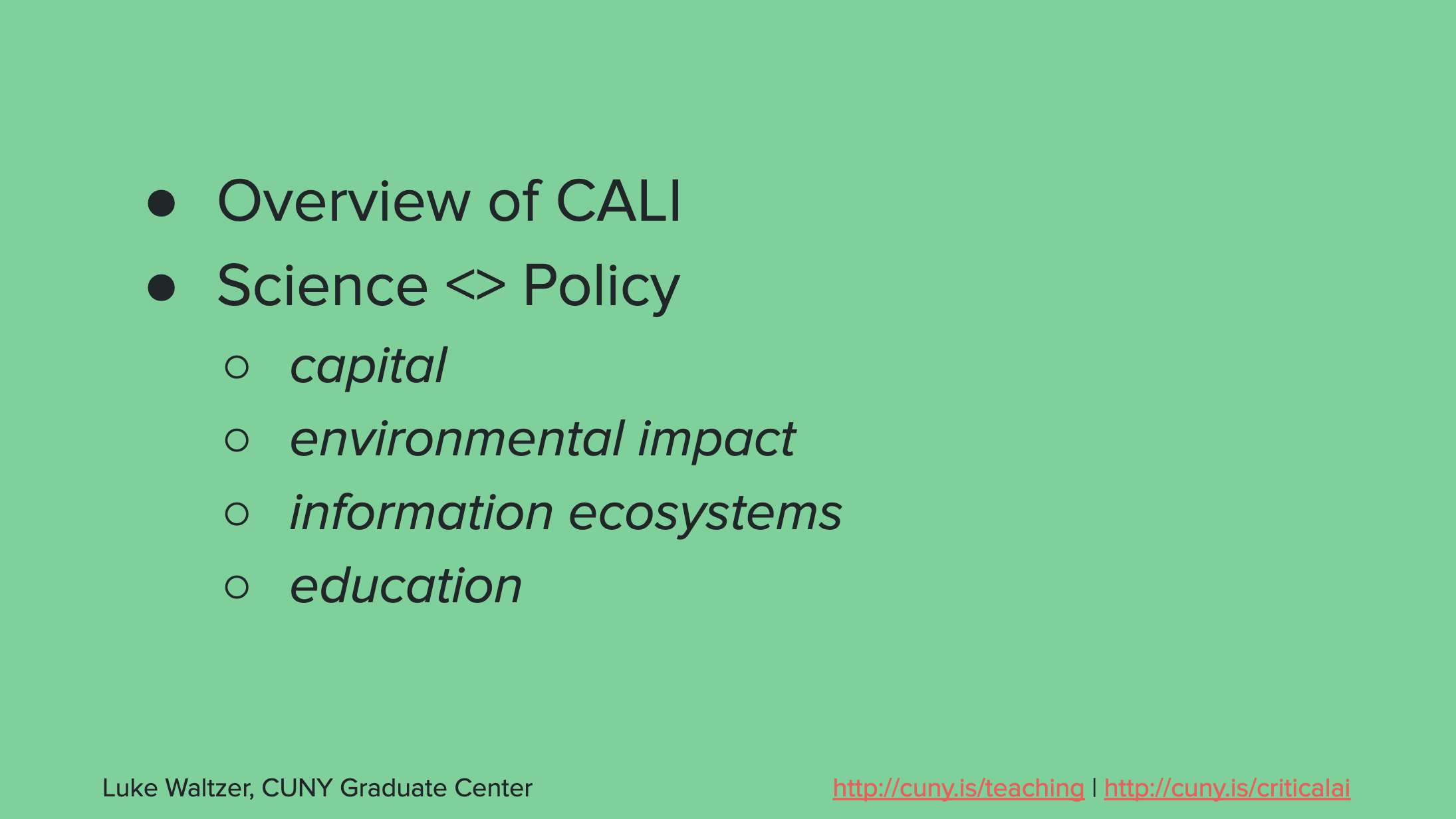
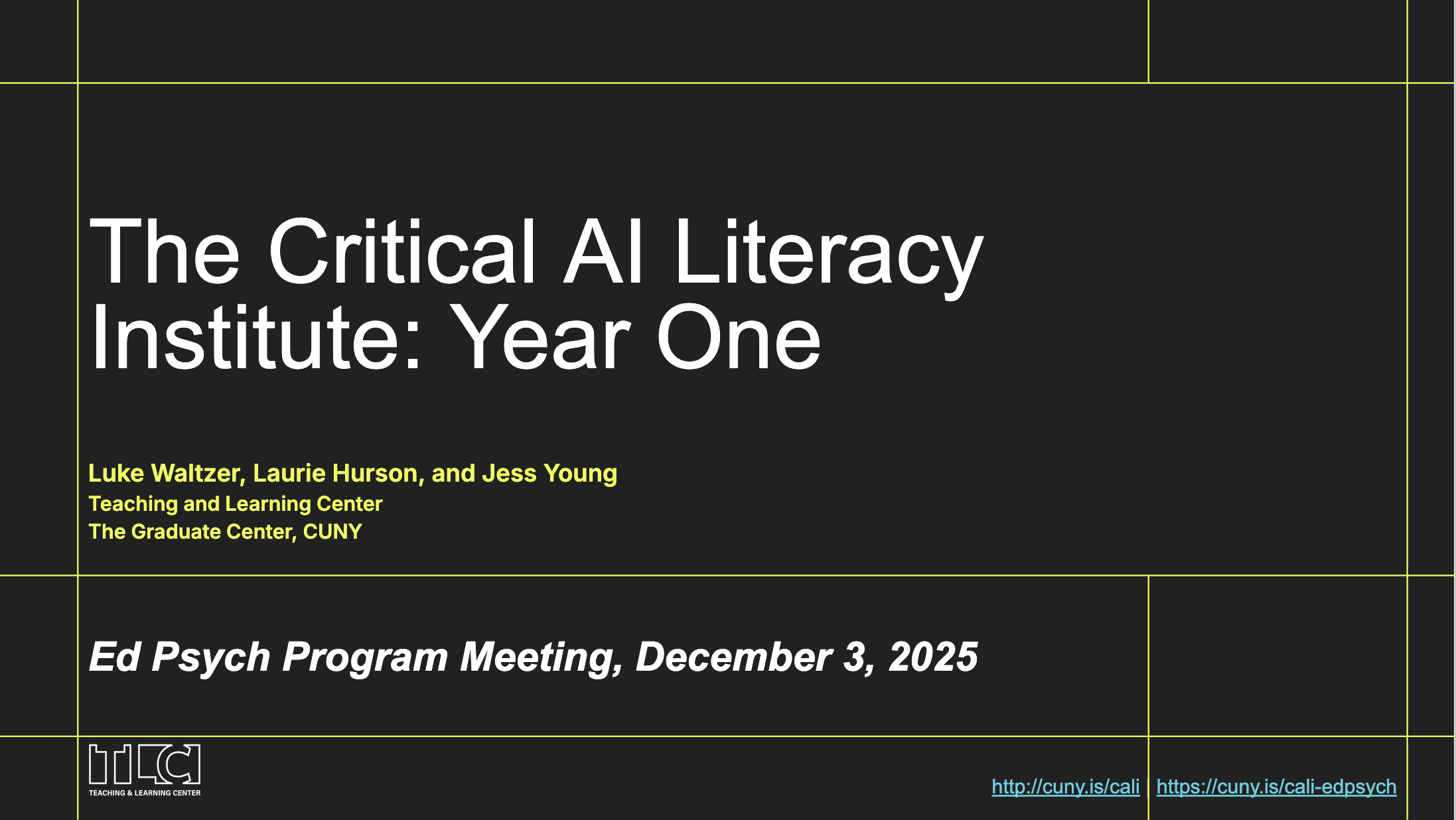
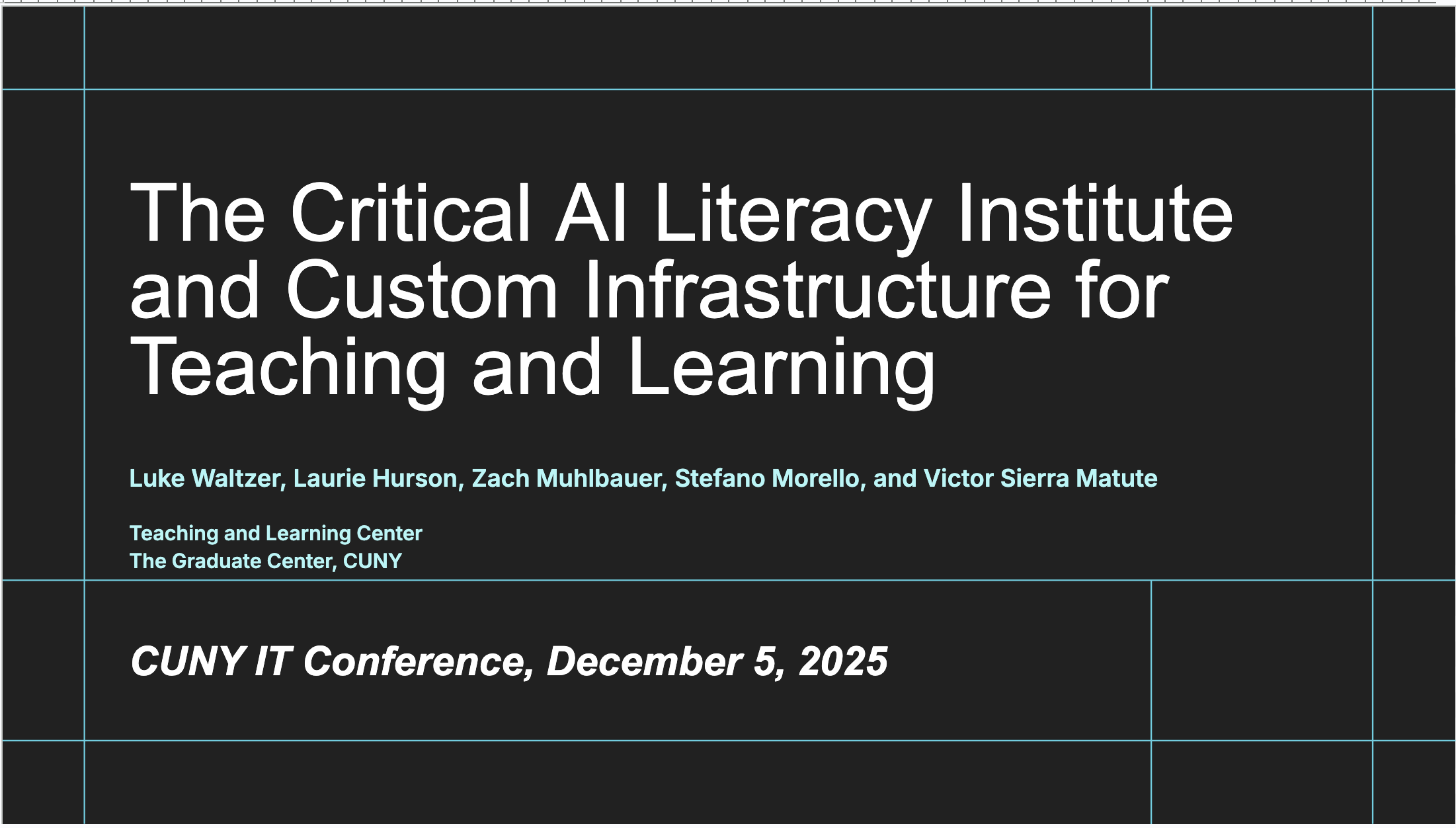
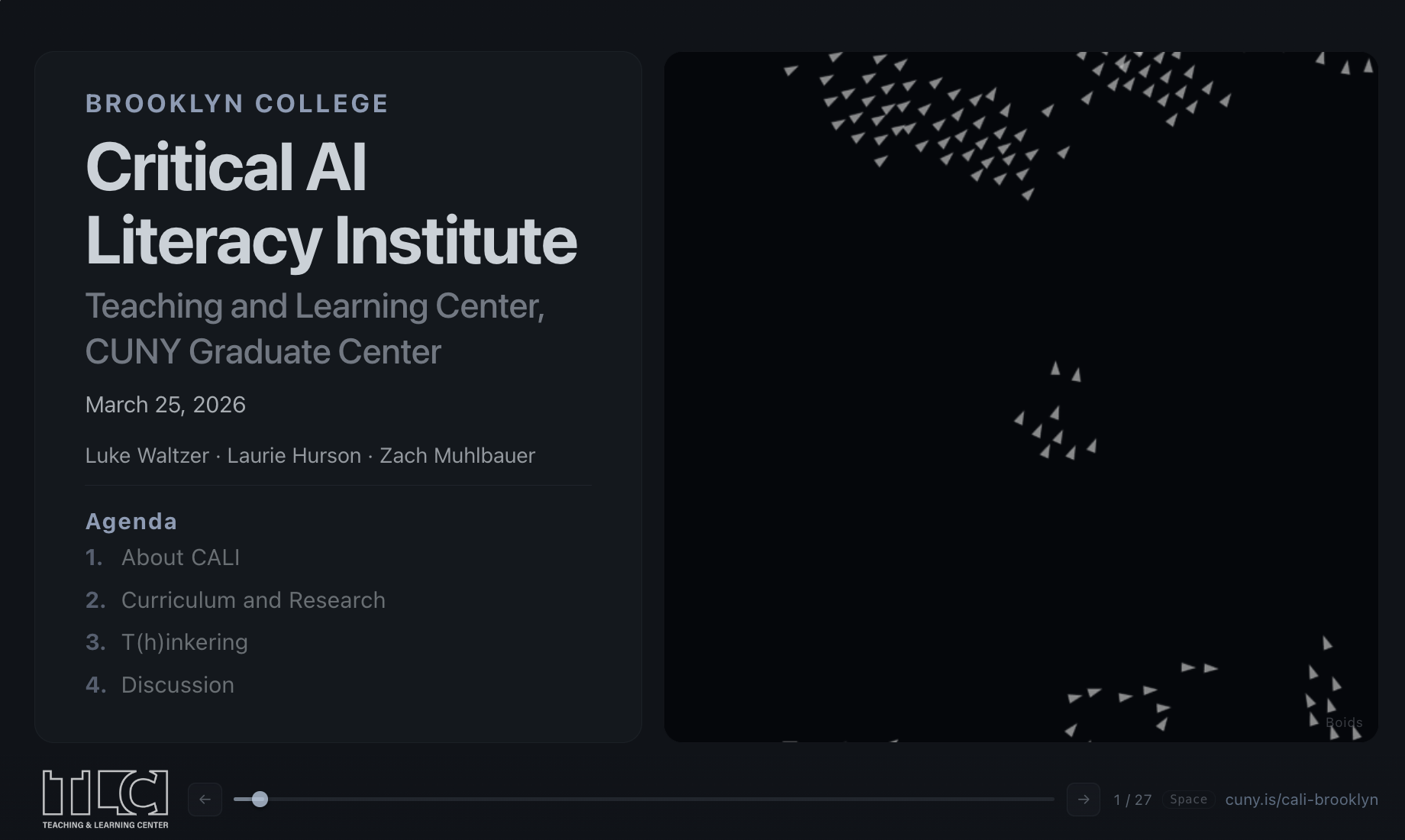
Zotero Library (Updated Frequently)
To access this project’s public Zotero library, visit https://www.zotero.org/groups/6197170/cuny_cali/library.
Selected Bibliography (Last Updated September 25, 2025)
| Books |
|---|
| Bender, Emily M., and Alex Hanna. The AI Con: How to Fight Big Tech’s Hype and Create the Future We Want. Harper. |
| Crawford, Kate. Atlas of AI: Power, Politics, and the Planetary Costs of Artificial Intelligence. Yale University Press, 2021. |
| Hao, Karen. Empire of AI: Dreams and Nightmares in Sam Altman’s OpenAI. Penguin Press, 2025. |
| Ilyés, Emese. AI and Positionality. 2025. pressbooks.cuny.edu, https://pressbooks.cuny.edu/aiandpositionality/. |
| Levy, Dan, and Angela Pérez Albertos. Teaching Effectively with ChatGPT: A Practical Guide to Creating Better Learning Experiences for Your Students in Less Time. https://www.teachingeffectivelywithchatgpt.org/. |
| Narayanan, Arvind, and Sayash Kapoor. AI Snake Oil: What Artificial Intelligence Can Do, What It Can’t, and How to Tell the Difference. Princeton University Press, 2024. press.princeton.edu, https://press.princeton.edu/books/hardcover/9780691249131/ai-snake-oil. |
| Thomas, David, and Lisa Forbes. Professors at Play AI PlayBook. Play Story Press, https://professorsatplay.org/ai-playbook/. Accessed 6 Sep. 2024. |
| Vallor, Shannon. The AI Mirror: How to Reclaim Our Humanity in an Age of Machine Thinking. Oxford University Press, 2024. |
| Watters, Audrey. Teaching Machines: The History of Personalized Learning. MIT Press, 2021. |
| Weinberg, Lindsay. Smart University: Student Surveillance in the Digital Age. Johns Hopkins University Press, 2024. |
| Wooldridge, Michael. A Brief History of Artificial Intelligence. Flatiron Books, 2021. |
| Journal Articles and Preprints |
|---|
| Baack, Stefan, et al. “Towards Best Practices for Open Datasets for LLM Training.” arXiv:2501.08365, arXiv, 14 Jan. 2025. arXiv.org, https://doi.org/10.48550/arXiv.2501.08365. |
| Baidoo-Anu, David, and Leticia Owusu Ansah. “Education in the Era of Generative Artificial Intelligence (AI): Understanding the Potential Benefits of ChatGPT in Promoting Teaching and Learning.” SSRN Scholarly Paper 4337484, Social Science Research Network, 25 Jan. 2023. papers.ssrn.com, https://doi.org/10.2139/ssrn.4337484. |
| Bastani, Hamsa, et al. “Generative AI Can Harm Learning.” SSRN Scholarly Paper 4895486, Social Science Research Network, 15 Jul. 2024. papers.ssrn.com, https://doi.org/10.2139/ssrn.4895486. |
| Bender, Emily M., et al. “On the Dangers of Stochastic Parrots: Can Language Models Be Too Big? 🦜.” [New York, NY, USA], FAccT ’21, 2021, pp. 610–23. ACM Digital Library, https://doi.org/10.1145/3442188.3445922. |
| Bender, Emily M., and Batya Friedman. “Data Statements for Natural Language Processing: Toward Mitigating System Bias and Enabling Better Science.” Transactions of the Association for Computational Linguistics, vol. 6, Dec. 2018, pp. 587–604. DOI.org (Crossref), https://doi.org/10.1162/tacl_a_00041. |
| Berman, Glen, et al. “Troubling Taxonomies in GenAI Evaluation.” arXiv:2410.22985, 30 Oct. 2024. arXiv.org, https://doi.org/10.48550/arXiv.2410.22985. |
| Cheng, Jingwen, et al. “REALM: A Dataset of Real-World LLM Use Cases.” arXiv:2503.18792, 24 Mar. 2025. arXiv.org, https://doi.org/10.48550/arXiv.2503.18792. |
| Conrad, Kathryn. “A Blueprint for an AI Bill of Rights for Education.” Critical AI, vol. 2, no. 1, Apr. 2024. Silverchair, https://doi.org/10.1215/2834703X-11205245. |
| Cox, Andrew. “Algorithmic Literacy, AI Literacy and Responsible Generative AI Literacy.” Journal of Web Librarianship, vol. 0, no. 0, pp. 1–18. Taylor and Francis+NEJM, https://doi.org/10.1080/19322909.2024.2395341. |
| Driessens, Olivier, and Magda Pischetola. “Danish University Policies on Generative AI: Problems, Assumptions and Sustainability Blind Spots.” MedieKultur: Journal of Media and Communication Research, vol. 40, no. 76, 76, Aug. 2024, pp. 31–52. tidsskrift.dk, https://doi.org/10.7146/mk.v40i76.143595. |
| Gebru, Timnit, et al. “Datasheets for Datasets.” arXiv:1803.09010, arXiv, 1 Dec. 2021. arXiv.org, https://doi.org/10.48550/arXiv.1803.09010. |
| Guest, Olivia, et al. “Against the Uncritical Adoption of ‘AI’ Technologies in Academia.” Zenodo, 5 Sep. 2025. Zenodo, https://zenodo.org/records/17065099. |
| Harvey, Emma, et al. “‘Don’t Forget the Teachers’: Towards an Educator-Centered Understanding of Harms from Large Language Models in Education.” arXiv:2502.14592, arXiv, 20 Feb. 2025. arXiv.org, https://doi.org/10.48550/arXiv.2502.14592. |
| Kay, Jackie, et al. “Epistemic Injustice in Generative AI.” arXiv:2408.11441, arXiv, 21 Aug. 2024. arXiv.org, https://doi.org/10.48550/arXiv.2408.11441. |
| Kirschenbaum, Matthew, and Rita Raley. “AI and the University as a Service.” PMLA, Oct. 2024, pp. 1–12. Cambridge University Press, https://doi.org/10.1632/S003081292400052X. |
| Klein, Lauren, et al. “Provocations from the Humanities for Generative AI Research.” arXiv:2502.19190, arXiv, 26 Feb. 2025. arXiv.org, https://doi.org/10.48550/arXiv.2502.19190. |
| Knoth, Nils, et al. “Developing a Holistic AI Literacy Assessment Matrix – Bridging Generic, Domain-Specific, and Ethical Competencies.” Computers and Education Open, vol. 6, Jun. 2024, p. 100177. ScienceDirect, https://doi.org/10.1016/j.caeo.2024.100177. |
| Laquintano, Timothy, and Annette Vee. “AI and the Everyday Writer.” PMLA, Oct. 2024, pp. 1–6. Cambridge University Press, https://doi.org/10.1632/S0030812924000609. |
| Larson, Barbara Z., et al. “Critical Thinking in the Age of Generative AI.” Academy of Management Learning & Education, vol. 23, no. 3, Sep. 2024, pp. 373–78. journals.aom.org (Atypon), https://doi.org/10.5465/amle.2024.0338. |
| Law, Locky. “Application of Generative Artificial Intelligence (GenAI) in Language Teaching and Learning: A Scoping Literature Review.” Computers and Education Open, vol. 6, Jun. 2024, p. 100174. ScienceDirect, https://doi.org/10.1016/j.caeo.2024.100174. |
| Lintner, Tomáš. “A Systematic Review of AI Literacy Scales.” Npj Science of Learning, vol. 9, no. 1, Aug. 2024, pp. 1–11. www-nature-com.ezproxy.gc.cuny.edu, https://doi.org/10.1038/s41539-024-00264-4. |
| Liu, Pengfei, et al. “Pre-Train, Prompt, and Predict: A Systematic Survey of Prompting Methods in Natural Language Processing.” arXiv:2107.13586, arXiv, 28 Jul. 2021. arXiv.org, https://doi.org/10.48550/arXiv.2107.13586. |
| Long, Duri, and Brian Magerko. “What Is AI Literacy? Competencies and Design Considerations.” Proceedings of the 2020 CHI Conference on Human Factors in Computing Systems [New York, NY, USA], CHI ’20, 2020, pp. 1–16. ACM Digital Library, https://doi.org/10.1145/3313831.3376727. |
| Malyn-Smith, Joyce, et al. “Developing a Framework for Computational Thinking from a Disciplinary Perspective.” Proceedings of the International Conference on Computational Thinking Education, 2018. Zotero, https://d-miller.github.io/DRK12/topic1/7440.pdf. |
| Mollick, Ethan R., and Lilach Mollick. “Assigning AI: Seven Approaches for Students, with Prompts.” SSRN Scholarly Paper 4475995, Social Science Research Network, 23 Sep. 2023. papers.ssrn.com, https://doi.org/10.2139/ssrn.4475995. |
| Narayanan, Arvind and Sayash Kapoor. “AI as Normal Technology.” Knight First Amendment Institute, Apr. 2025, http://knightcolumbia.org/content/ai-as-normal-technology. |
| Newfield, Christopher. “How to Make ‘AI’ Intelligent; or, The Question of Epistemic Equality.” Critical AI, vol. 1, nos. 1–2, Oct. 2023. Silverchair, https://doi.org/10.1215/2834703X-10734076. |
| Ng, Davy Tsz Kit, et al. “AI Literacy: Definition, Teaching, Evaluation and Ethical Issues.” Proceedings of the Association for Information Science and Technology, vol. 58, no. 1, 2021, pp. 504–09. Wiley Online Library, https://doi.org/10.1002/pra2.487. |
| Nichols, T. Philip, et al. “Generative AI and the (Re)Turn to Luddism.” Learning, Media and Technology, vol. 0, no. 0, pp. 1–14. Taylor and Francis+NEJM, https://doi.org/10.1080/17439884.2025.2452199. |
| Nygren, Christopher, and Sonja Drimmer. “Art History and AI: Ten Axioms.” International Journal for Digital Art History, no. 9, Apr. 2023, p. 5.02-5.13. journals.ub.uni-heidelberg.de, https://doi.org/10.11588/dah.2023.9.90400. |
| Selwyn, Neil. “On the Limits of Artificial Intelligence (AI) in Education.” Nordisk Tidsskrift for Pedagogikk Og Kritikk, vol. 10, no. 1, 1, Jan. 2024. pedagogikkogkritikk.no, https://doi.org/10.23865/ntpk.v10.6062. |
| ———. “When the Prompting Stops: Exploring Teachers’ Work around the Educational Frailties of Generative AI Tools.” Learning, Media and Technology, vol. 0, no. 0, pp. 1–14. Taylor and Francis+NEJM, https://doi.org/10.1080/17439884.2025.2537959. |
| Singh, Smriti, et al. “Born With a Silver Spoon? Investigating Socioeconomic Bias in Large Language Models.” arXiv:2403.14633, arXiv, 16 Apr. 2024. arXiv.org, https://doi.org/10.48550/arXiv.2403.14633. Vaswani, Ashish, et al. “Attention Is All You Need.” arXiv:1706.03762, arXiv, 2 Aug. 2023. arXiv.org, https://doi.org/10.48550/arXiv.1706.03762. |
| Suarez, Marcela, et al. Critical AI Literacy: Beyond Hegemonic Perspectives on Sustainability. Jun. 2025. Zenodo, https://zenodo.org/records/15677840. |
| Waelen, Rosalie A. “Simon Lindgren – A Critical Theory of AI.” AI & SOCIETY, Feb. 2025. Springer Link, https://doi.org/10.1007/s00146-025-02205-0. |
| Wang, Jin, and Wenxiang Fan. “The Effect of ChatGPT on Students’ Learning Performance, Learning Perception, and Higher-Order Thinking: Insights from a Meta-Analysis.” Humanities and Social Sciences Communications, vol. 12, no. 1, May 2025, pp. 1–21. www.nature.com, https://doi.org/10.1057/s41599-025-04787-y. |
| Blog Posts and Magazine and News Articles |
|---|
| ADAPT: A Generative AI Course Design Checklist. 12 Jun. 2025, https://jimmcgrath.us/teaching/adapt-a-generative-ai-course-design-checklist/. |
| Bali, Maha. “Critical AI Literacy Is Not Enough: Introducing Care Literacy, Equity Literacy & Teaching Philosophies. A Slide Deck.” Reflecting Allowed, 15 Oct. 2024, https://blog.mahabali.me/educational-technology-2/critical-ai-literacy-is-not-enough-introducing-care-literacy-equity-literacy-teaching-philosophies-a-slide-deck/. |
| Benjamin, Ruha. The New Artificial Intelligentsia. https://lareviewofbooks.org/article/the-new-artificial-intelligentsia/. |
| Bogost, Ian. College Students Have Already Changed Forever. 17 Aug. 2025, https://www.theatlantic.com/technology/archive/2025/08/ai-college-class-of-2026/683901/. |
| “Building Bridges of Knowledge (BBK).” The City University of New York, https://www.cuny.edu/academics/faculty-affairs/cuny-innovative-teaching-academy/building-bridges-of-knowledge-bbk/. Accessed 18 Apr. 2025. |
| Burke, Timothy. “Academia: Dispatches From the AI Front.” Substack newsletter. Eight by Seven, 8 May 2025, https://timothyburke.substack.com/p/academia-dispatches-from-the-ai-front. |
| ———. “Academia: Exploring AI Uses (I).” Substack newsletter. Eight by Seven, 27 May 2025, https://timothyburke.substack.com/p/academia-exploring-ai-uses-i. |
| ———. “Academia: Is AI Hype? (Yes).” Substack newsletter. Eight by Seven, 13 May 2025, https://timothyburke.substack.com/p/academia-is-ai-hype-yes. |
| Burnett, D. Graham. “Will the Humanities Survive Artificial Intelligence?” The New Yorker, 26 Apr. 2025. www.newyorker.com, https://www.newyorker.com/culture/the-weekend-essay/will-the-humanities-survive-artificial-intelligence. |
| Carr, Nicholas. The Myth of Automated Learning. 10 Mar. 2025, https://www.newcartographies.com/p/the-myth-of-automated-learning?post_id=163771392&r=7udoh. |
| Cassidy, John. “How to Survive the A.I. Revolution.” The New Yorker, 14 Apr. 2025. www.newyorker.com, https://www.newyorker.com/magazine/2025/04/21/how-to-survive-the-ai-revolution. |
| Caulfield, Mike. “AI Is Not Your Friend.” The Atlantic, 9 May 2025, https://www.theatlantic.com/technology/archive/2025/05/sycophantic-ai/682743/. Technology. |
| ———. “The Two Meanings of Reasoning and the Future Path of AI.” Substack newsletter. The End(s) of Argument, 29 Dec. 2024, https://mikecaulfield.substack.com/p/the-two-meanings-of-reasoning-and?utm_campaign=post&showWelcomeOnShare=true. |
| Chayka, Kyle. “AI Is Homogenizing Our Thoughts.” The New Yorker, 25 Jun. 2025, https://www.newyorker.com/culture/infinite-scroll/ai-is-homogenizing-our-thoughts. |
| ———. “The Limits of A.I.-Generated Miyazaki.” The New Yorker, 2 Apr. 2025. Infinite Scroll. www.newyorker.com, https://www.newyorker.com/culture/infinite-scroll/the-limits-of-ai-generated-miyazaki. |
| Grabar, Henry. “We’re Focused on the Wrong A.I. Problem in Journalism.” Slate, 21 May 2025. slate.com, https://slate.com/technology/2025/05/ai-chatgpt-controversy-fake-books-chicago-sun-times-philadelphia-inquirer.html |
| “How Open Education Can Support Digital Literacy.” EdTech Factotum, 18 Nov. 2024, https://edtechfactotum.com/how-open-education-can-support-digital-literacy/. |
| Hsu, Hua. “What Happens After A.I. Destroys College Writing?” The New Yorker, 30 Jun. 2025. www.newyorker.com, https://www.newyorker.com/magazine/2025/07/07/the-end-of-the-english-paper. |
| Jones, Spencer Lane. “What Are Students Using AI For?” Substack newsletter. The Important Work, 9 Jan. 2025, https://theimportantwork.substack.com/p/what-are-students-using-ai-for?publication_id=3312111&utm_campaign=email-post-title&r=g4n6t&utm_medium=email. |
| Liu, Yukun, et al. “Research: Gen AI Makes People More Productive—and Less Motivated.” Harvard Business Review. hbr.org, https://hbr.org/2025/05/research-gen-ai-makes-people-more-productive-and-less-motivated. Accessed 14 May 2025. |
| Marcus, Gary. “LLMs Don’t Do Formal Reasoning – and That Is a HUGE Problem.” Substack newsletter. Marcus on AI, 11 Oct. 2024, https://garymarcus.substack.com/p/llms-dont-do-formal-reasoning-and. |
| More Work for Teacher? The Ironies of GenAI as a Labour-Saving Technology. 20 Mar. 2025, https://criticaledtech.com/2025/03/20/more-work-for-teacher-the-ironies-of-genai-as-a-labour-saving-technology/. |
| Mollick, Ethan. On Working with Wizards. 7 Aug. 2025, https://www.oneusefulthing.org/p/on-working-with-wizards?utm_medium=web. |
| Morozov, Evgeny. “The AI We Deserve.” Boston Review, 4 Dec. 2024. Boston Review, https://www.bostonreview.net/forum/the-ai-we-deserve/. |
| Narayanan, Arvind. Is AI Progress Slowing Down? 20 Mar. 2023, https://www.aisnakeoil.com/p/is-ai-progress-slowing-down?utm_medium=web. |
| O’Donnell, James, and Casey Crownhart. “We Did the Math on AI’s Energy Footprint. Here’s the Story You Haven’t Heard.” MIT Technology Review, https://www.technologyreview.com/2025/05/20/1116327/ai-energy-usage-climate-footprint-big-tech/. Accessed 20 May 2025. |
| Pahwa, Nitish. “They Have Their Doubts.” Slate, 15 Jul. 2025. School. slate.com, https://slate.com/life/2025/07/ai-college-cheating-gemini-chatgpt-students-policy.html. |
| Rothman, Joshua. “Are We Taking A.I. Seriously Enough?” The New Yorker, 1 Apr. 2025. www.newyorker.com, https://www.newyorker.com/culture/open-questions/are-we-taking-ai-seriously-enough. |
| ———. “Two Paths for A.I.” The New Yorker, 27 May 2025. www.newyorker.com, https://www.newyorker.com/culture/open-questions/two-paths-for-ai. |
| Seybold, Matt. “Against Technofeudal Education.” Substack newsletter. The American Vandal, 10 Jun. 2025, https://theamericanvandal.substack.com/p/against-technofeudal-education. |
| Walsh, James D. “Everyone Is Cheating Their Way Through College.” New York Magazine, 7 May 2025, https://nymag.com/intelligencer/article/openai-chatgpt-ai-cheating-education-college-students-school.html. |
| Warner, John. Addressing the Transactional Model of School. 11 Dec. 2022, https://biblioracle.substack.com/p/addressing-the-transactional-model?utm_medium=ios. |
| Warner, John Bailey, John. “AI Tutors: Hype or Hope for Education?” Education Next, 3 Dec. 2024, https://www.educationnext.org/ai-tutors-hype-or-hope-for-education-forum/. |
| Watkins, Marc. “The Costs of AI in Education.” Substack newsletter. Rhetorica, 21 Feb. 2025, https://marcwatkins.substack.com/p/the-costs-of-ai-in-education?utm_campaign=post&triedRedirect=true. |
| Williamson, Ben. “AI in Education Is a Public Problem.” Code Acts in Education, 22 Feb. 2024, https://codeactsineducation.wordpress.com/2024/02/22/ai-in-education-is-a-public-problem/. |
| ———. Critical Keywords of AI in Education. 8 Nov. 2024, https://codeactsineducation.wordpress.com/2024/11/08/critical-keywords-of-ai-in-education/. |
| ———. Enumerating AI Effects in Education. 28 May 2025, https://codeactsineducation.wordpress.com/2025/05/28/enumerating-ai-effects-in-education/. |
| ———. Performing AI Literacy. 30 Apr. 2025, https://codeactsineducation.wordpress.com/2025/04/30/performing-ai-literacy/. |
| Working Paper 1: Overview of the Issues, Statement of Principles, and Recommendations – MLA-CCCC Joint Task Force on Writing and AI. https://aiandwriting.hcommons.org/working-paper-1/. Accessed 31 Oct. 2024. |
| Working Paper 2: Generative AI and Policy Development: Guidance from the MLA-CCCC Task Force – MLA-CCCC Joint Task Force on Writing and AI. https://aiandwriting.hcommons.org/working-paper-2/. Accessed 31 Oct. 2024. |
| Young, Jeff. Why AI Is So Thirsty: Data Centers Use Massive Amounts of Water. https://www.newsweek.com/why-ai-so-thirsty-data-centers-use-massive-amounts-water-1882374. |
| Websites |
|---|
| AIxDESIGN. Slow AI. https://aixdesign.co/posts/slow-ai. |
| Carl T. Bergstrom and Jevin D. West. “The Bullshit Machines.” Online Course. The Bullshit Machines, https://thebullshitmachines.com/. |
| Crawford, Kate, and Trevor Paglen. “Excavating AI.” Article. Excavating AI, https://excavating.ai. |
| Kapoor, Sayash. AI Snake Oil | Sayash Kapoor | Substack. 4 Oct. 2024, https://www.aisnakeoil.com/. Mind. https://moebio.com/mind/. |
| Models All The Way Down. https://knowingmachines.org/models-all-the-way. |
| Teach@CUNY AI Toolkit – Critical Strategies and Resources for CUNY Instructors. https://aitoolkit.commons.gc.cuny.edu/. |

This entry is licensed under a Creative Commons Attribution-NonCommercial-ShareAlike 4.0 International license.

